Browse the reference library
CALCULATOR REFERENCE
TIPS ladder calculator methodology
The calculator keeps the original 2026 product’s annual cash-flow and par-purchase convention. It is a planning estimate, not a list of executable trades.
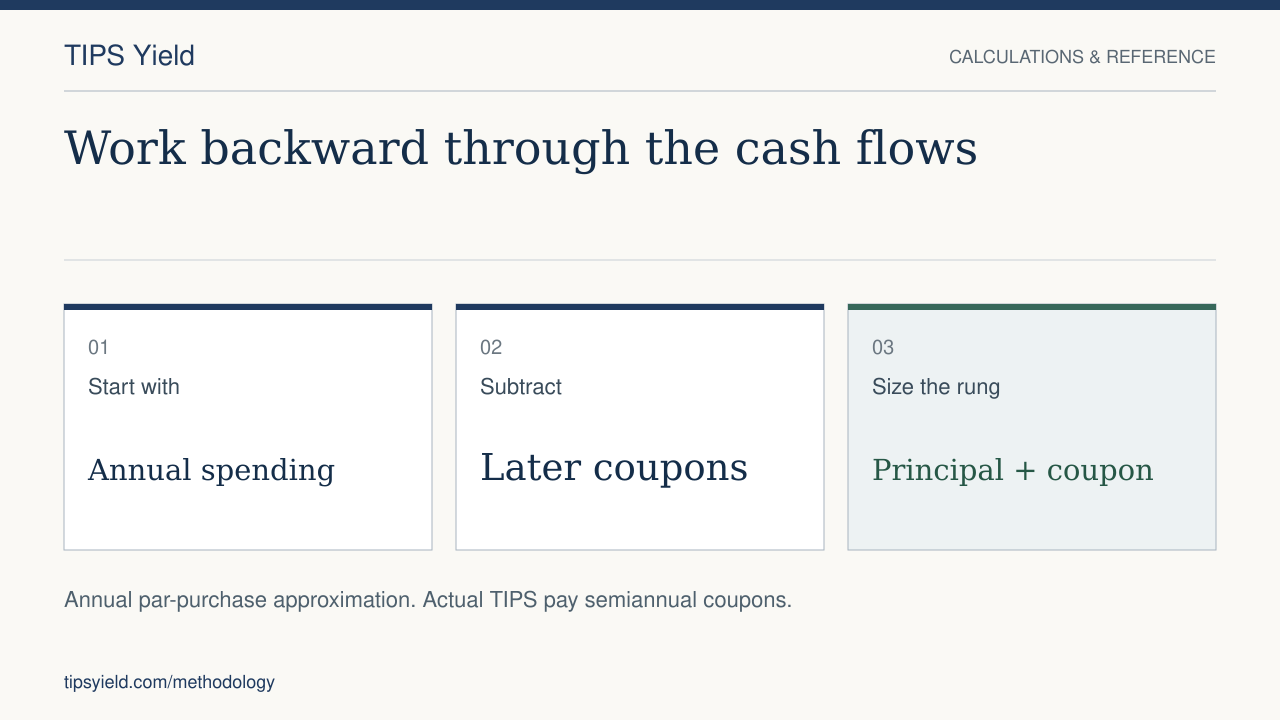
The model, step by step
- Assign an income target to each maturity year, in today’s dollars.
- Interpolate real yields between your 5-, 10-, and 30-year assumptions. Shorter maturities use the 5-year assumption.
- Assume an annual coupon rate equal to the greater of the real yield or 0.125%.
- Work backward. Size each rung so its principal and coupon, plus coupons from later rungs, cover that year’s target.
- Assume the purchase cost equals the calculated principal. Add the rung costs for the total.
Where this approximation matters
Actual TIPS pay semiannual coupons and trade at market prices. The tool omits security-specific prices, accrued interest, inflation index ratios, spreads, taxes, and reinvestment of surplus coupons. Coupons received before the first target year are not credited against the cost.
When the assumed real yield is below the minimum coupon, the par-price approximation can understate the price of a bond. Those results display a warning. Negative real yields require particular care: this is not a market-price model.
Missing maturities and uneven targets
The 2037–2039 rows are hypothetical planning placeholders. Their costs are included in the total, but there are no corresponding maturities available today. If later coupons exceed an income target, the tool buys zero principal for that rung and flags the surplus instead of treating it as a negative bond purchase.
Website and workbook
Both use the same underlying par-purchase convention. The downloadable 2026 workbook is a separate, fixed-edition asset and does not update when this site changes. Review its formulas for very uneven spending patterns; the website explicitly prevents negative rung purchases.
Source and observation dates
The yield service reads Treasury data with FRED as a fallback. The page shows the observation date, not just the time the data was fetched. If fresh data is unavailable, the most recent saved reference is shown and labeled. Yields remain editable.