TIPS funds vs individual TIPS
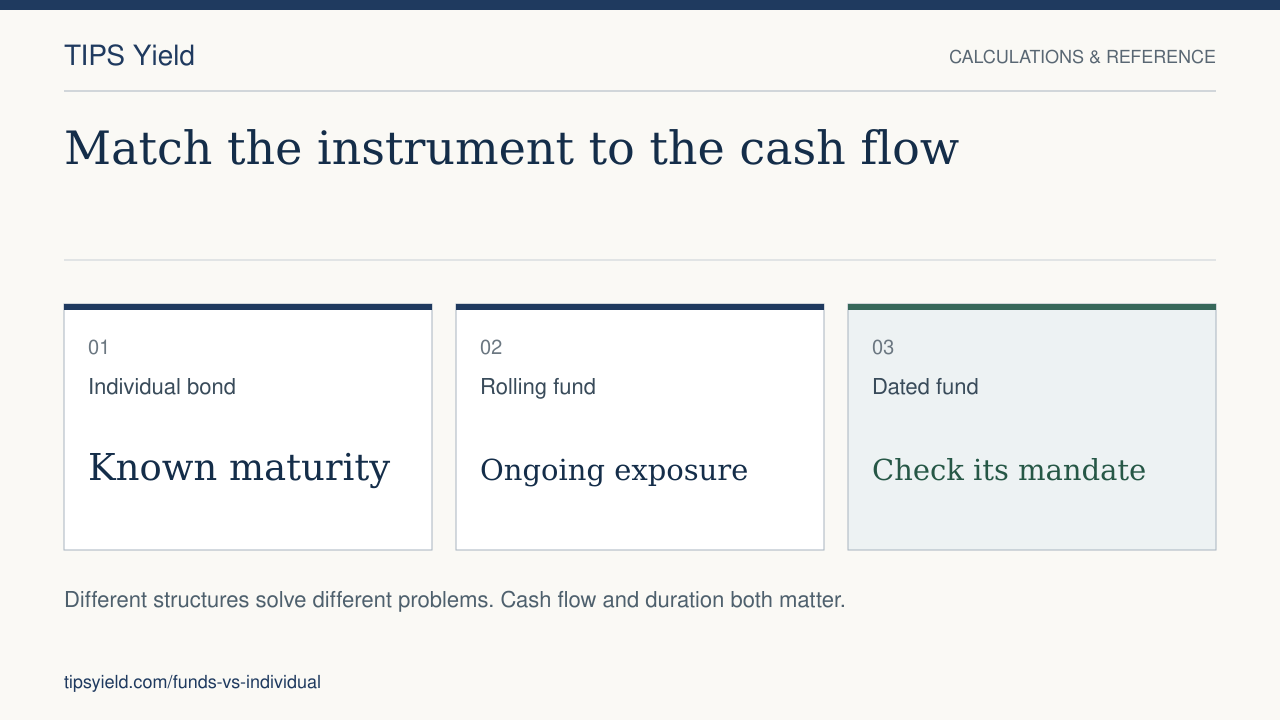
An individual TIPS has a set maturity date. A conventional rolling TIPS fund keeps a portfolio of bonds in a target maturity range and replaces them as they age. Both give inflation-linked exposure, but they do not deliver cash on the same schedule.
Compare the job before the ticker
| Feature | Individual TIPS ladder | Conventional rolling TIPS fund |
|---|---|---|
| Scheduled principal | Each bond repays its adjusted principal at maturity | No scheduled repayment of your investment on a personal spending date |
| Price risk over time | Shrinks as each bond nears maturity | Stays roughly constant, because the fund keeps its maturity range |
| Ongoing work | Select bonds, manage cash dates and handle missing maturities | Fund manages the bonds. You manage purchases, sales and distributions |
| Cash between maturities | Coupons every six months. A cash reserve may be needed | Fund distributions on its own schedule. Amounts vary |
| Value if sold early | Market price, which can be below cost | Share price, which can be below cost |
| Costs | Brokerage spreads and any fees | Expense ratio plus trading spread and any brokerage fees |
| Minimum | $100 at a Treasury auction. Broker minimums vary | One share, or less where fractional shares are offered |
Why inflation protection can coexist with a price loss
Inflation adjustments are only one part of a bond's return. If market real yields rise, the present value of existing cash flows falls. Longer duration means more price sensitivity.
For a hypothetical duration of six years, a one-point rise in real yields implies roughly a 6% price decline, before convexity, carry and other changes. Inflation accrual over the same period may not offset that. This is an illustration, not a forecast or a fund-return claim.
Treasury's own auction records show it happening. The 30-year TIPS maturing in February 2052 sold for $9,810.27 per $10,000 of face amount in February 2022. When Treasury reopened it in August 2022, it sold for $8,461.53. Its inflation-adjusted principal had risen 6.25% in between. Its price still fell 13.75%, because its real yield rose from 0.195% to 0.920%. Any fund holding long TIPS marked its bonds to prices like these every day.
Holding to maturity: a 2022 example
Now take a bond bought in the same year and held. The 5-year TIPS maturing April 15, 2027 (CUSIP 91282CEJ6) was first sold in April 2022 at a real yield of −0.34%. Buyers paid $10,276.26 per $10,000 of face amount, plus a small amount of accrued interest.
Its dated-date reference CPI is 282.34640. For October 15, 2026, the reference CPI is 334.39761, built from July and August 2026 CPI-U. That gives an index ratio of 1.18435 and an adjusted principal of about $11,843.50 per $10,000 of face amount. In April 2027 the holder receives the adjusted principal on that date, whatever the bond's price did in 2022.
The holder locked in a real yield of −0.34%, a small loss of purchasing power over five years. That was known on the purchase date. The holder of a rolling fund over the same period had no locked outcome. The result depended on the yield path and on when shares were sold.
Auction price and index ratio from TreasuryDirect auction records. Index ratio for October 15, 2026 calculated by TIPS Yield from BLS CPI-U with the method in 31 CFR Part 356, Appendix B. Treasury's published ratio is the official value.
Duration drift, and why it matters
An individual bond's price sensitivity falls as it ages. A 10-year TIPS bought today becomes a 5-year bond in five years and a 1-year bond in nine. By the time you need the money, little price risk is left.
A rolling fund keeps buying new bonds to stay in its range. A fund of 0–5 year TIPS stays a short fund. A broad fund keeps its longer duration. Neither ever converges to a known payoff on your spending date. That is the core difference, and it matters more than the expense ratio.
Holding a bond to maturity avoids selling at an interim market price. It does not remove tax, liquidity, opportunity-cost or spending-mismatch concerns. A fund investor selling shares to pay a bill gets the share price on that day.
What the fund costs
Expense ratios on broad and short TIPS index ETFs can be very low. Our SCHP versus VTIP comparison found 0.03% for both when checked in September 2026. On a $10,000 balance that is about $3 a year. An individual ladder has no expense ratio, but you pay a bid-ask spread on each purchase and possibly a sale.
Cost alone rarely decides this. The question is whether you need principal on known dates or a constant-duration allocation.
Defined-maturity funds are a separate category
Some bond ETFs do mature. iShares describes its iBonds structure as paying a final distribution in its stated maturity year. That payout is not a promise to return your original purchase price.
Check the fund's holdings, inflation protection, fees, termination policy and available years. A category label does not make it equivalent to a direct TIPS ladder. These ETFs are also different from Treasury Series I savings bonds. See TIPS ladder ETFs for more.
Two planning examples
For a known tuition or retirement bill, compare a matching individual maturity with the date of the expense. For an ongoing bond allocation inside a portfolio, consider how a rolling fund's duration and low upkeep fit the broader mix.
Neither removes the need for a cash plan. A ladder can have missing maturity years, and a fund may have to be sold during a decline. Review gap-year choices and tax cash flows.
Next steps
Use the worked ladder example and the ladder calculator for date-specific spending. For fund exposure, compare TIPS ETFs by mandate and duration, then see SCHP versus VTIP. Do not choose by the largest displayed distribution yield. What are TIPS explains the inflation adjustment itself.
Frequently asked questions
Is a TIPS ETF better than buying TIPS directly?
It depends on the job. Individual TIPS repay principal on known dates, which suits planned spending. A fund is simpler to hold as part of an allocation but has no maturity date, so its value on your spending date is unknown.
Can a TIPS fund lose money when inflation is high?
Yes. In 2022, inflation was high but real yields rose sharply, and longer TIPS fell in price by more than their inflation adjustments. A fund holding those bonds reflects those prices.
Do individual TIPS lose value if rates rise?
Their market price falls, but a holder who keeps the bond to maturity receives the adjusted principal. The price drop only becomes a realized loss if you sell.
What does a TIPS fund cost?
Expense ratios for large TIPS index ETFs can be as low as 0.03%, or $3 a year per $10,000. Check each sponsor's current figure.
Are defined-maturity TIPS funds the same as a ladder?
Not exactly. They pay out in a stated year, but the payout is not a fixed amount. Check holdings, fees and termination terms before treating one as a ladder rung.