TIPS ladder: how it works, with a cash-flow example
A TIPS ladder is a collection of Treasury Inflation-Protected Securities chosen to mature in different years. Its purpose is to match future spending with principal repayments and interest payments. You begin with the income years you need, then work out how much each maturity must contribute.
The important distinction is that a ladder spends principal as well as interest. A plan that provides $40,000 a year is not necessarily earning $40,000 a year. Some of that cash is your original investment coming back.
What adjusts for inflation?
TIPS principal changes with the inflation index used by the Treasury. The coupon rate is fixed, but its dollar payment changes because interest is calculated on adjusted principal. TIPS pay interest every six months. At maturity, Treasury pays the inflation-adjusted principal or original principal, whichever is higher. TreasuryDirect: TIPS
That maturity protection applies to original principal. It should not be described as a promise to return every dollar a secondary-market buyer paid, including a premium. A market quote, the amount paid at settlement, and the bond's original face amount are different quantities.
For planning, it helps to express spending in today's dollars first. A $40,000 real spending target means the purchasing power of $40,000 today, rather than the same nominal dollar amount in every future year. Your personal expenses can rise differently from the Treasury's inflation measure.
Start with the shortfall you need to fund
Write down the spending that needs funding in each year. Identify the portion covered by other income and whether that income itself adjusts with inflation. A temporary bridge before another income source begins can look very different from a level 30-year spending plan.
Decide whether the numbers are before or after tax. An estimate of pretax bond cash flow is not automatically an estimate of spendable income. Also identify money that must remain accessible outside the ladder and spending that may continue after its last maturity.
A three-year example you can check
Suppose we are planning at the end of 2026 for $40,000 of spending in each of 2027, 2028 and 2029, expressed in today's dollars.
To make the arithmetic easy to inspect, assume a flat 2% real yield, an annual 2% coupon, and purchase cost equal to principal. These are the same simplifying conventions used by the current Tipsyield calculator. This is a hypothetical annual cash-flow model, not an executable bond order. Actual TIPS use semiannual payments and security-specific market prices.
Work backward from the final year. In 2029, the last rung must provide its principal plus that year's coupon:
2029 principal = $40,000 / 1.02 = $39,215.69
That rung also contributes approximately $784.31 of annual coupon income before maturity in this simplified model. The 2028 rung therefore needs to cover only the part of $40,000 that the later bond's coupon does not cover. Repeat the process for 2027.
| Spending year | Principal returned by that year's rung | Coupon from that rung | Coupons from later rungs | Total cash available |
|---|---|---|---|---|
| 2027 | $37,692.89 | $753.86 | $1,553.25 | $40,000.00 |
| 2028 | $38,446.75 | $768.94 | $784.31 | $40,000.00 |
| 2029 | $39,215.69 | $784.31 | $0.00 | $40,000.00 |
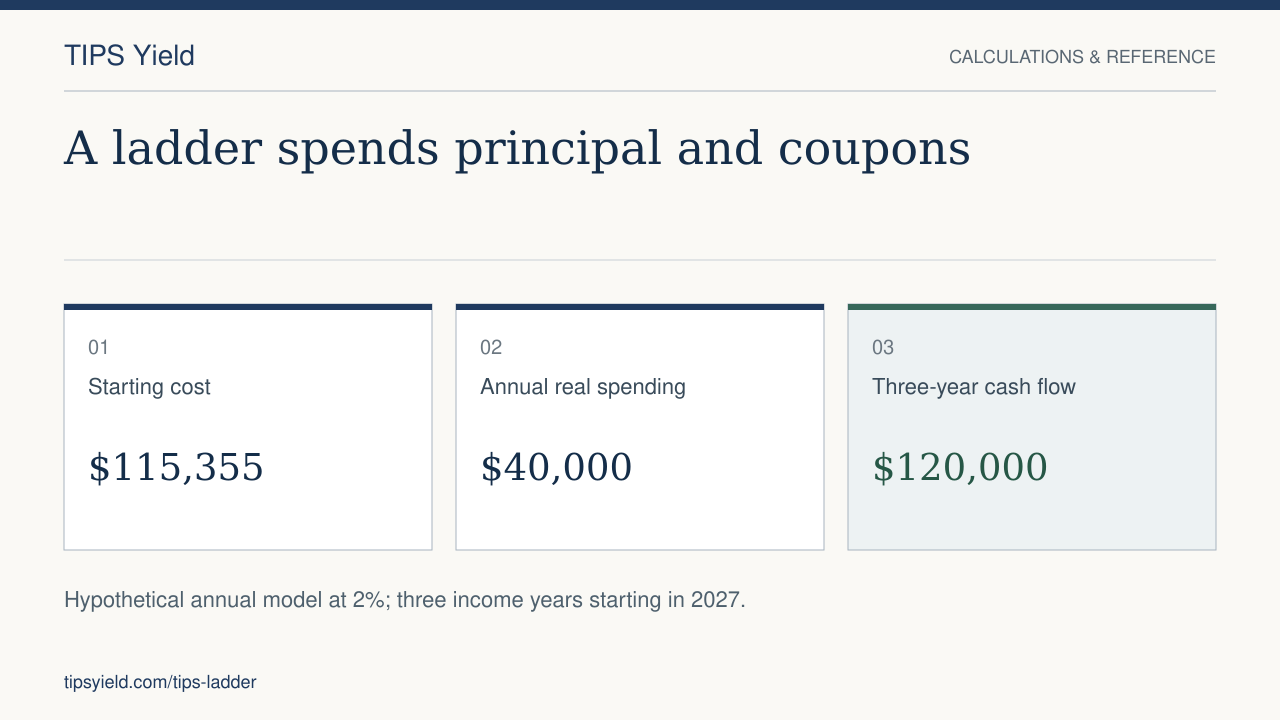
The approximate starting cost is $115,355.33. Over the three years, the model provides $120,000 of total cash flow. The difference, approximately $4,644.67, comes from modeled coupons. Figures are rounded for display; calculations use full precision.
This explains why simply buying $40,000 of face amount for every year would overfund the target under these assumptions: coupons from the other rungs contribute too.
It also explains what happens at the end. After the final principal payment is spent, this three-year ladder has no remaining bond principal. A longer life or additional spending requires resources beyond these three years.
You can reproduce the example in the free calculator: use annual income of $40,000, first year 2027, last year 2029, and set all three advanced yield assumptions to 2%. The model reference year for the figures above is 2026.
Why an actual purchase will differ
The example is useful for understanding cash-flow matching. It omits security-specific prices, accrued interest, inflation index ratios, trading spreads, tax and the timing of semiannual payments. Actual coupon rates do not simply become the current yield when you buy an existing bond.
The calculator also does not select CUSIPs or produce executable quotes. Its par-purchase assumption needs particular caution when yields are low or negative. Review the methodology before treating an estimate as a budget for actual orders.
Annual coverage is only the first step. If bills are monthly and bond cash arrives on particular dates, prepare a cash reserve and a payment schedule. A year with enough total income can still contain a month when cash is short.
What if there is no bond for a spending year?
As of the site's September 2026 planning assumptions, 2037–2039 are flagged as missing maturity years. The calculator includes hypothetical costs for those rows, so they remain part of the estimate. A placeholder is not a bond you can buy.
The broad choices are to reserve funds for possible future issues, use an earlier maturity and hold cash for later spending, or plan to sell a later-maturing bond. Each leaves a different uncertainty: the future purchase yield, inflation while holding cash, or the future sale price.
Consult the dated gap-year explanation and current Treasury announcements before placing orders. Future issuance should be described as expected until announced. In particular, a bond maturing after a spending date cannot fund that earlier expense without a sale or another source of cash.
Where taxes enter the plan
For a taxable holding, inflation-related increases in principal can create reportable income during the year even when that principal has not been paid in cash. The IRS explains this under its rules for inflation-indexed debt instruments. IRS Publication 550
That is why the account and the tax cash flow belong in the plan before buying. Retirement-account treatment, withdrawal rules, available investments and your wider tax situation affect the comparison. Read the phantom-income reference and check the rules for your circumstances; the table above contains no tax estimate.
A checklist before buying
- List the income years and spending shortfall in today's dollars.
- Decide how taxes and cash needed between payment dates will be funded.
- Run an estimate and read its assumptions, including missing maturities.
- Find actual securities and verify coupon, maturity, real yield, index ratio and total settlement cost.
- Reconcile actual payment dates with the spending schedule, then check for unfunded years or excess cash.
- Record what you purchased and how the plan will be reviewed if spending changes.
The buying guide explains the auction and secondary-market routes. Treasury's announcements and results are the primary source for announced securities and auction information.
Put your own numbers into the plan
Start with the free TIPS ladder calculator. Use its result to understand the scale of the plan and the questions an actual purchase needs to resolve.
For an organized reference and worksheets you can revisit, the TIPS Primer and Excel workbook include Ladder Builder, Gap Years and Phantom Income worksheets. Read the sample to judge whether the paid guide fits your needs.
Sources cited on this page: TreasuryDirect · IRS