TIPS maturity schedule
A ladder needs bonds that pay principal when spending is due. This inventory lists TIPS that had been issued and had not matured on the snapshot date. Reopenings are grouped under one CUSIP, and an announced new issue is left out until its issue date.
Outstanding securities
Treasury snapshot checked · 52 distinct issued securities. Download maturity CSV.
| CUSIP | Maturity | Annual coupon |
|---|---|---|
| 912810PS1 | 2027-01-15 | 2.38% |
| 912828V49 | 2027-01-15 | 0.38% |
| 91282CEJ6 | 2027-04-15 | 0.13% |
| 9128282L3 | 2027-07-15 | 0.38% |
| 91282CFR7 | 2027-10-15 | 1.63% |
| 912810PV4 | 2028-01-15 | 1.75% |
| 9128283R9 | 2028-01-15 | 0.50% |
| 912810FD5 | 2028-04-15 | 3.63% |
| 91282CGW5 | 2028-04-15 | 1.25% |
| 912828Y38 | 2028-07-15 | 0.75% |
| 91282CJH5 | 2028-10-15 | 2.38% |
| 912810PZ5 | 2029-01-15 | 2.50% |
| 9128285W6 | 2029-01-15 | 0.88% |
| 912810FH6 | 2029-04-15 | 3.88% |
| 91282CKL4 | 2029-04-15 | 2.13% |
| 9128287D6 | 2029-07-15 | 0.25% |
| 91282CLV1 | 2029-10-15 | 1.63% |
| 912828Z37 | 2030-01-15 | 0.13% |
| 91282CNB3 | 2030-04-15 | 1.63% |
| 912828ZZ6 | 2030-07-15 | 0.13% |
| 91282CPH8 | 2030-10-15 | 1.13% |
| 91282CBF7 | 2031-01-15 | 0.13% |
| 91282CQP9 | 2031-04-15 | 1.25% |
| 91282CCM1 | 2031-07-15 | 0.13% |
| 91282CDX6 | 2032-01-15 | 0.13% |
| 912810FQ6 | 2032-04-15 | 3.38% |
| 91282CEZ0 | 2032-07-15 | 0.63% |
| 91282CGK1 | 2033-01-15 | 1.13% |
| 91282CHP9 | 2033-07-15 | 1.38% |
| 91282CJY8 | 2034-01-15 | 1.75% |
| 91282CLE9 | 2034-07-15 | 1.88% |
| 91282CML2 | 2035-01-15 | 2.13% |
| 91282CNS6 | 2035-07-15 | 1.88% |
| 91282CPU9 | 2036-01-15 | 1.88% |
| 91282CRE3 | 2036-07-15 | 2.38% |
| 912810QF8 | 2040-02-15 | 2.13% |
| 912810QP6 | 2041-02-15 | 2.13% |
| 912810QV3 | 2042-02-15 | 0.75% |
| 912810RA8 | 2043-02-15 | 0.63% |
| 912810RF7 | 2044-02-15 | 1.38% |
| 912810RL4 | 2045-02-15 | 0.75% |
| 912810RR1 | 2046-02-15 | 1.00% |
| 912810RW0 | 2047-02-15 | 0.88% |
| 912810SB5 | 2048-02-15 | 1.00% |
| 912810SG4 | 2049-02-15 | 1.00% |
| 912810SM1 | 2050-02-15 | 0.25% |
| 912810SV1 | 2051-02-15 | 0.13% |
| 912810TE8 | 2052-02-15 | 0.13% |
| 912810TP3 | 2053-02-15 | 1.50% |
| 912810TY4 | 2054-02-15 | 2.13% |
| 912810UH9 | 2055-02-15 | 2.38% |
| 912810US5 | 2056-02-15 | 2.38% |
An outstanding bond is not necessarily in your broker's inventory at an acceptable price or quantity. This is a maturity reference, not a list of executable trades.
How to read a row
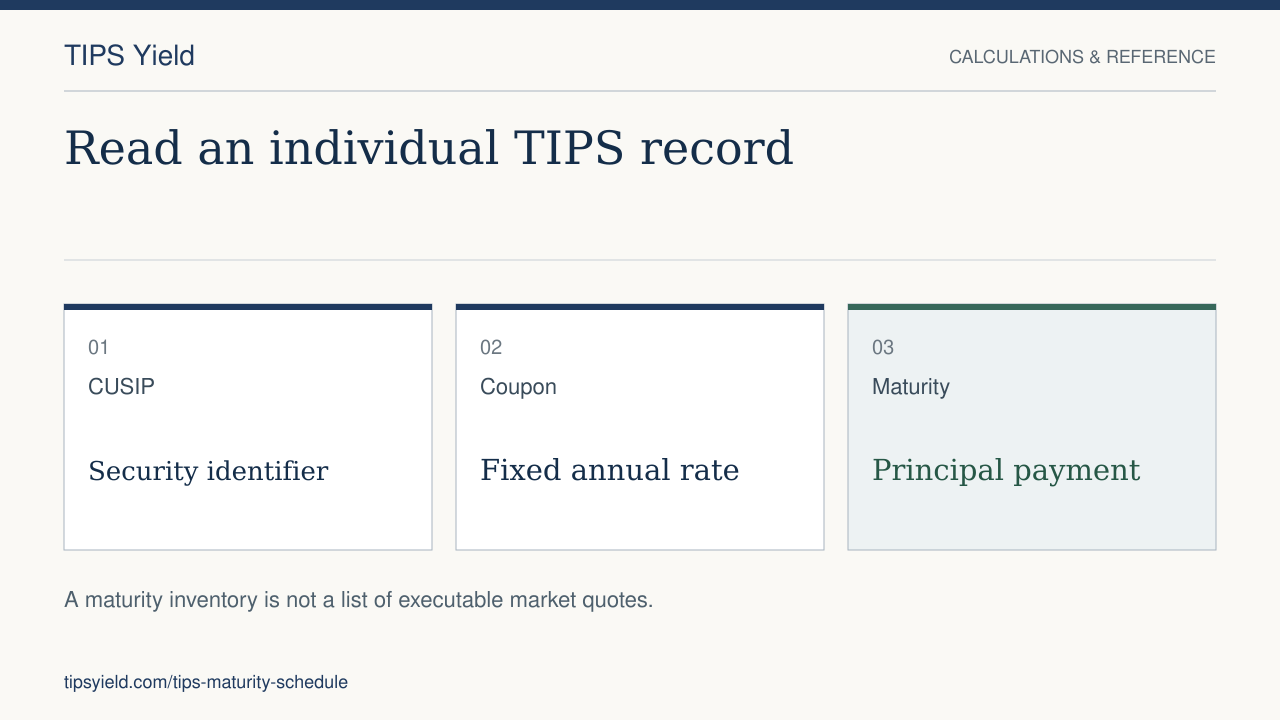
The maturity date is when the bond's principal is due. The coupon is the stated annual rate applied to adjusted principal. It is not today's real yield. The CUSIP identifies the security so an auction record or broker ticket can be matched to it.
A January maturity and a July maturity in the same year can fund different spending dates. Build a cash reserve for expenses that arrive before the bond pays. Year-level coverage is not month-level matching.
Where each maturity month comes from
The month tells you which Treasury program issued the bond. Treasury sells 5-year TIPS in April and October, 10-year TIPS in January and July, and 30-year TIPS in February, according to TreasuryDirect. Older programs explain the rest.
| Maturity month | Source in the October 6, 2026 snapshot |
|---|---|
| January and July | 10-year TIPS, plus three January bonds from the 20-year program of 2007 to 2009 (maturing 2027, 2028 and 2029) |
| April and October | 5-year TIPS, plus three April bonds from the original 30-year issues of 1998, 1999 and 2001 (maturing 2028, 2029 and 2032) |
| February | 30-year TIPS issued every year since 2010, one per year from 2040 through 2056 |
So the near years are crowded and the far years are thin. In the October 6, 2026 snapshot, 2027 through 2029 have five or six maturities each. 2030 through 2036 have two to four. 2040 onward has exactly one bond per year, each maturing February 15. There are none in 2037, 2038 or 2039.
Missing years
In the 2026-10-23 snapshot, missing calendar years between 2027 and 2056: 2037, 2038, 2039. Coverage is based on issued securities in this inventory.
No TIPS program has ever produced a maturity in those years. The 20-year bonds ended with a 2029 maturity. The 30-year program restarted in 2010 with a 2040 maturity. The newest 10-year bond matures in 2036. The calculator's flagged years are planning placeholders. Read the gap-year alternatives before assuming a numbered row means a bond can be bought.
Same year, very different bonds
Two bonds maturing in the same month can behave very differently. The older one has a higher index ratio, because inflation has been accruing since it was issued. It may also have a much higher coupon.
| Bond | Issued | Coupon | Index ratio, Oct. 15, 2026 | Adjusted principal per $1,000 face | Annual interest per $1,000 face |
|---|---|---|---|---|---|
| January 15, 2028 (912810PV4) | 2008, 20-year | 1.750% | 1.59620 | $1,596.20 | $27.93 |
| January 15, 2028 (9128283R9) | 2018, 10-year | 0.500% | 1.35567 | $1,355.67 | $6.78 |
| April 15, 2028 (912810FD5) | 1998, 30-year | 3.625% | 2.06750 | $2,067.50 | $74.95 |
| April 15, 2028 (91282CGW5) | 2023, 5-year | 1.250% | 1.11485 | $1,114.85 | $13.94 |
Index ratios calculated by TIPS Yield from BLS CPI-U using the method in 31 CFR Part 356, Appendix B. The same method reproduces the index ratios in Treasury's auction records for these bonds. Treasury's published ratios are the official values. Interest is adjusted principal × coupon, and changes with each new ratio.
Three practical points follow from the table.
- Face amount is not cost. $1,000 face of the 1998 bond has more than $2,000 of principal behind it. You pay for that accrued inflation when you buy.
- Coupons change the ladder math. The 3.625% bond pays about eleven times the interest per $1,000 face of the 0.5% January bond. A high-coupon rung sends more cash to earlier years and less at maturity.
- The deflation floor matters less for old bonds. The floor protects $1,000 per $1,000 face at maturity. With an index ratio above 2, it would take a very large fall in prices before that floor came into play.
When two bonds mature on the same date, compare their real yields and settlement costs, not their face amounts. The price calculation guide shows how.
Match the inventory to a plan
- Write the spending need and the date it must be available.
- Identify candidate maturities and coupon dates.
- Check actual broker availability, quantity and settlement cost.
- Include coupons from other rungs when sizing the principal.
- Keep a record of any funding year that still relies on a future purchase or sale.
The ladder example shows how coupons and principal combine. The ladder calculator flags missing years automatically. The cost examples show what a 10-, 20- or 30-year ladder costs at different yields.
Source and limitations
The inventory is derived from TreasuryDirect auction records. Reopenings are deduplicated, and the most recent issued record supplies the coupon. Announced future reopenings appear on the auction calendar, not as extra securities here.
The snapshot is dated. It does not refresh on your screen and should be checked against Treasury and your broker before a purchase. Downloads include CUSIPs and stated coupons. They do not contain live yields, broker quotes or advice.
Frequently asked questions
When do TIPS mature?
On the 15th of January, February, April, July or October, depending on the program that issued them. 10-year TIPS mature in January and July, 5-year TIPS in April and October, and 30-year TIPS in February.
Why are there no TIPS maturing in 2037, 2038 or 2039?
No TIPS has been issued with a term that ends in those years. If Treasury keeps its current schedule, 10-year TIPS issued in 2027, 2028 and 2029 would fill them.
What is the longest TIPS maturity?
In the October 6, 2026 snapshot it is February 15, 2056, from the 30-year TIPS first issued in February 2026.
Can I buy an older TIPS that is not being auctioned?
Yes, through a broker on the secondary market, subject to the broker's inventory and price. TreasuryDirect only sells TIPS at auction.
Why do two TIPS maturing the same day cost different amounts?
They have different coupons and different index ratios. An older bond has more accrued inflation in its principal and often a higher coupon, so each $1,000 of face costs more.