Short-term TIPS ETFs: STIP and VTIP compared
A short-term TIPS ETF holds inflation-protected Treasuries with 0 to 5 years left until maturity. Two widely held ones are the iShares 0-5 Year TIPS Bond ETF (STIP) and the Vanguard Short-Term Inflation-Protected Securities ETF (VTIP). Both charge 0.03%. This page compares them, explains what short duration buys and gives up, and shows where a single TIPS bought for your date differs.
STIP and VTIP side by side
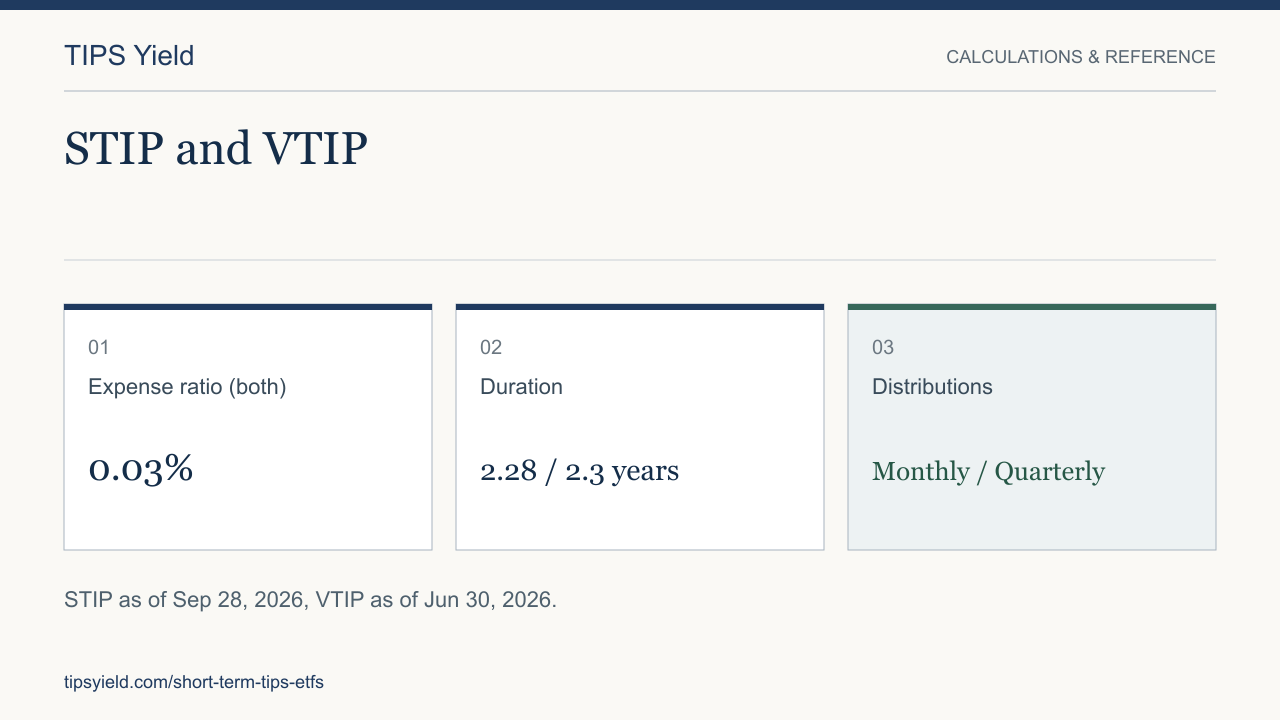
| Measure | STIP (iShares) | VTIP (Vanguard) |
|---|---|---|
| Data as of | September 28, 2026 | June 30, 2026 |
| Expense ratio | 0.03% | 0.03% |
| Duration | 2.28 years | 2.3 years |
| Maturity | Weighted average 2.38 years | Average effective 2.4 years |
| Holdings | 25 | 25 |
| Distributions | Monthly | Quarterly |
| Net assets | $16.38 billion | $19,343 million (ETF share class) |
| Index | ICE U.S. Treasury 0-5 Year Inflation Linked Bond Index | Bloomberg U.S. TIPS 0-5 Year Index |
| Inception | December 1, 2010 | October 12, 2012 |
Sources: iShares STIP and the Vanguard VTIP factsheet, checked September 29, 2026. The two dates differ, so this is not a synchronized snapshot. iShares also lists an ICPI 0-1 Year TIPS Bond ETF, which this page does not cover.
The funds are close to identical in cost, duration and holdings count. The practical differences are payment timing and the index each follows. STIP pays monthly and VTIP pays quarterly, which can matter if you spend the distributions.
What short duration buys
Duration estimates how far a fund's price moves when real yields change. A short duration means smaller moves. For a hypothetical one-point rise in real yields on $10,000, STIP's 2.28 years suggests about −$228 and VTIP's 2.3 years about −$230. A fund with a 6.3-year duration would show about −$630 in the same case, as on our Vanguard TIPS ETF page.
Short TIPS also track current inflation closely. Their principal adjusts with the CPI, and the bonds mature soon, so little of the value depends on long-term real yields. The distributions still vary, because inflation accruals move month to month. A trailing yield is not a forecast.
What short duration gives up
A short fund does not lock in today's long real yields. On September 28, 2026 the 10-year real yield was 2.90% and the 5-year real yield was 2.73%. A fund that keeps replacing maturing bonds buys at whatever real yield exists later. It does not hold today's 10-year rate for ten years. Our real yields page shows the history, and the 5-year page tracks the shorter end.
When short TIPS fit
Short TIPS suit cash needs between one and five years away, such as a planned purchase or a bridge before other income starts. Its principal adjusts with CPI-U, which a savings account does not promise, and its price moves less than a broad fund's. It is still a fund. If you sell shares before you need the money, you get the market price, and early-sale risk applies even at short duration.
Fund versus an individual TIPS on your date
A fund never matures. Its bonds roll off and get replaced, so its price keeps changing. A single TIPS that matures on your spending date pays back its inflation-adjusted principal on that day if you hold it. That is the main reason some savers prefer bonds for a known bill. Check which years have bonds on the TIPS maturity schedule. The full comparison is on funds versus individual TIPS.
For a head-to-head with a broad fund, read SCHP versus VTIP. For the wider field, see best TIPS ETFs.
How the figures were computed
The price effect uses approximate price change = −duration × change in yield × starting value. For STIP: −2.28 × 0.01 × $10,000 = −$228. For VTIP: −2.3 × 0.01 × $10,000 = −$230. For a 6.3-year duration: −6.3 × 0.01 × $10,000 = −$630. The formula ignores convexity, coupon income, inflation accrual, fees and yield curve shape changes.
The gap between the 10-year and 5-year real yields is 2.90% minus 2.73%, or 0.17 percentage points. Both yields come from the Treasury daily par real yield curve for September 28, 2026, published at home.treasury.gov.