What are Treasury Inflation-Protected Securities?
Treasury Inflation-Protected Securities, or TIPS, are U.S. government bonds whose principal changes with an inflation index. They can help match future spending to purchasing power, but their market price can fall and their tax treatment needs attention.
One bond, two moving dollar amounts
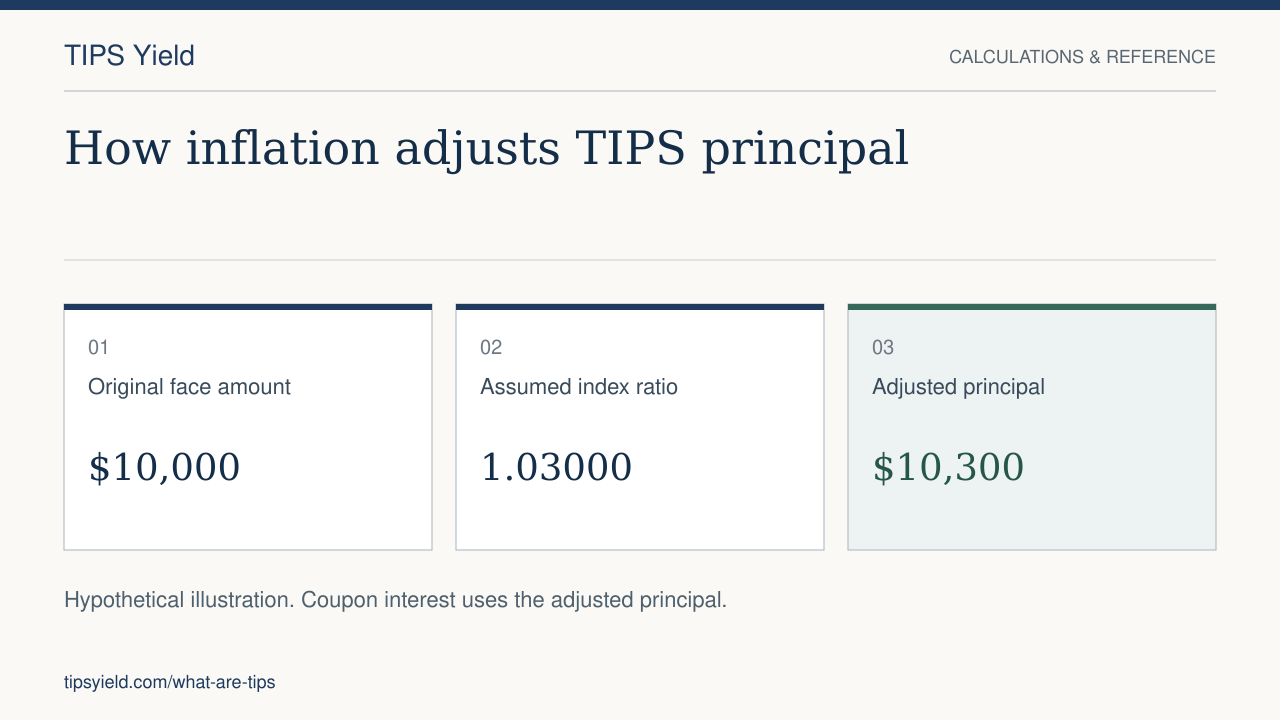
The coupon rate is fixed. The principal used to calculate each payment changes with Treasury's inflation index ratio. TIPS pay interest twice a year, and the maturity payment is the greater of adjusted principal and original face amount. TreasuryDirect explains the terms.
Here is an illustrative $10,000 original face amount with a 2% annual coupon. Each payment shown uses the index ratio on that hypothetical coupon date:
| Index ratio | Adjusted principal | Six-month coupon |
|---|---|---|
| 1.00000 | $10,000 | $100 |
| 1.03000 | $10,300 | $103 |
| 0.98000 | $9,800 | $98 |
The coupon formula is adjusted principal × annual coupon rate ÷ 2. The principal floor applies at maturity; it does not set a floor under every coupon or daily trading price. See Treasury's index-ratio instructions.
Coupon rate is not real yield
A coupon tells you how interest payments are calculated. Real yield reflects the price you pay relative to future inflation-adjusted cash flows. Two purchases of the same bond at different prices can have different yields even though the coupon is identical.
A quoted yield to maturity is a valuation measure. Turning it into a realized compounded return also involves the timing and reinvestment of coupons, costs and taxes. It should not be presented as a promise that every investor's account value rises by that percentage each year.
The Treasury real-yield curve provides reference rates. An actual bond order has its own maturity, price, coupon and settlement amount.
What is protected, and what is not?
| Concern | What to understand |
|---|---|
| Inflation | Principal follows the specified CPI measure with a lag; your household's expenses may rise differently. |
| Deflation | Adjusted principal and coupons can decrease. The maturity floor refers to original face amount, not a premium you paid. |
| Early sale | The sale price depends on market conditions and can be below your cost. |
| Taxes | A principal increase can generate current taxable income before it is paid in cash. |
| Long retirement | A ladder ends at its last planned year. It does not insure a lifetime of spending. |
How TIPS fit an income plan
An individual security can provide principal at a particular maturity. A ladder combines maturities and coupons across several spending years. A conventional rolling TIPS fund provides exposure to a portfolio, with a different cash-flow structure.
Compare the cash flows with your goal before choosing a wrapper. Someone funding a known bill has a different task from someone maintaining an inflation-sensitive allocation inside a larger portfolio.
Where to go next
Start with how to buy TIPS and the tax example. For the choice between inflation-adjusted and nominal bonds, read TIPS versus Treasuries; breakeven inflation is a useful reference, not a pure forecast or a personal investment rule.