How to buy TIPS
You can buy new TIPS at Treasury auctions or buy existing securities on the secondary market. For a ladder, start with the maturity dates you need: an auction only offers particular securities, while the secondary market may offer an existing bond for a specific year.
Auction or secondary market?
| Question | Treasury auction | Secondary market |
|---|---|---|
| Which bond? | The announced new issue or reopening | An existing security offered by a seller |
| When is the yield known? | After the auction; a noncompetitive order accepts its result | The displayed quote has a yield, subject to execution and availability |
| When can you buy? | During the order window | When the market and your broker are open and inventory is available |
| What needs checking? | Announcement, deadline, settlement date and account funding | Quote size, bid/ask spread, accrued interest, index ratio and total settlement |
A reopening adds to an existing issue. Its original coupon and maturity remain the same, but its auction price and yield can differ from the earlier sale. Check the auction calendar and Treasury announcements.
Where can you place an order?
| Venue | Minimum to verify | Practical consideration |
|---|---|---|
| TreasuryDirect | $100, in $100 increments | Direct auction access; to sell before maturity you must transfer to a bank, broker or dealer |
| Fidelity | Published TIPS denomination: $1,000 face amount | Auction and secondary-market access; order quantity is not necessarily the final dollar cost |
| Schwab, Vanguard or another broker | Check that broker's current ticket and fee schedule | Confirm account eligibility, order cutoff, online versus assisted fees, and secondary-market inventory |
Sources checked September 11, 2026: TreasuryDirect terms and Fidelity Treasury denominations. Broker procedures can change. A quoted “zero commission” does not eliminate a secondary-market spread.
Prepare an auction order
- Choose the account and confirm it permits the investment. TreasuryDirect does not provide an IRA account.
- Read the announced maturity, auction date, settlement date and minimum. A ten-year reopening has less than ten years remaining.
- Select a noncompetitive order if you intend to accept the auction result. The final yield is not locked when you enter it.
- Enter the face amount or broker quantity carefully. Confirm the units shown on the ticket.
- Check the broker's submission cutoff; it can precede Treasury's cutoff. Keep enough settled cash for the actual settlement.
- After allocation, record the CUSIP, coupon, maturity, face amount and amount paid.
Fidelity's Auto Roll service excludes TIPS. Check reinvestment settings separately for other Treasury holdings.
Why a $98 quote can cost more than $100
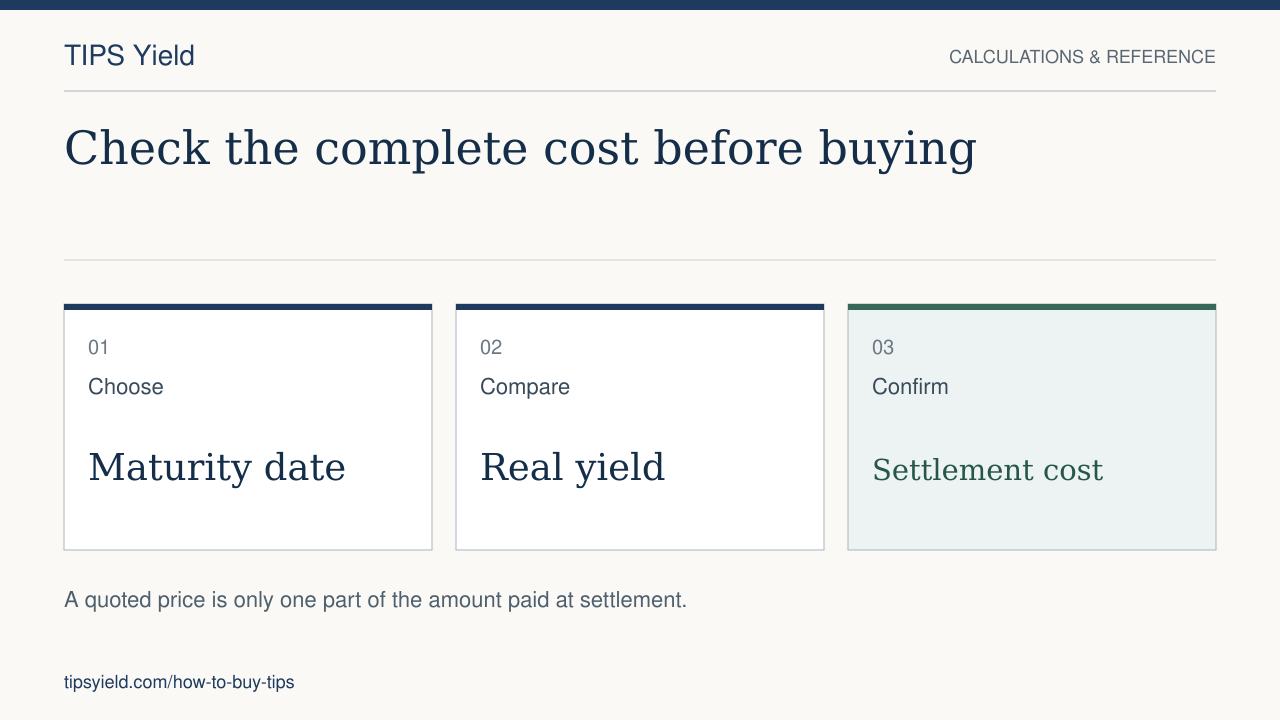
A TIPS clean price is generally quoted per $100 of original face amount. The inflation index ratio changes the principal on which that quote is applied. Accrued interest and any fees then affect the settlement amount.
For a hypothetical $10,000 face amount at a clean price of 98.00 and an index ratio of 1.10, the inflation-adjusted clean value is $10,780: $10,000 × 0.98 × 1.10. Add the inflation-adjusted accrued interest displayed on the ticket. Do not multiply that already-adjusted interest by the index ratio again.
Follow the complete quote-to-settlement example before comparing this number with a calculator estimate. The free calculator uses a simpler par-purchase convention.
Check the ladder before confirming
Review the maturity schedule, any missing years, and the dates cash is needed. Prepare a reserve for expenses between coupon and maturity dates. In a taxable account, include the annual tax cash flow.
Learn how the rungs work together, then use the free ladder calculator. The primer and workbook provide a reusable reference for organizing the plan.