TIPS price calculation: how to work out a purchase price
A clean price of 98 does not mean $10,000 face amount of TIPS will cost $9,800 at settlement. The quote applies to inflation-adjusted principal, and the buyer may also owe accrued interest and fees.
The four numbers to identify
- Original face amount: the quantity of original principal you are buying.
- Clean price: the quote per $100 of face amount, excluding accrued interest.
- Settlement index ratio: the factor Treasury uses to adjust original principal for inflation.
- Accrued interest: payment to the seller for the elapsed part of the coupon period.
Use the index ratio for the actual settlement date. Treasury publishes CUSIP-specific index ratios. A statement's market value, an auction result and an order ticket can show different components.
Step 1: the index ratio
The index ratio is the reference CPI for the settlement date divided by the reference CPI for the bond's dated date. The rules are in 31 CFR Part 356, Appendix B:
- The reference CPI for the first day of a month is the non-seasonally adjusted CPI-U for the third preceding month.
- For any other day, interpolate: Ref CPI = CPI(month − 3) + (day − 1) ÷ (days in month) × [CPI(month − 2) − CPI(month − 3)].
- The index ratio is rounded to five decimals.
Worked example for the 10-year TIPS maturing July 15, 2036 (CUSIP 91282CRE3), reopened with settlement on September 30, 2026:
| Item | Calculation | Result |
|---|---|---|
| Dated date reference CPI (July 15, 2026) | April CPI 333.020 + 14/31 × (May 335.123 − 333.020) | 333.96974 |
| Settlement reference CPI (September 30, 2026) | June CPI 333.952 + 29/30 × (July 333.918 − 333.952) | 333.91913 |
| Index ratio | 333.91913 ÷ 333.96974 | 0.99985 |
CPI-U values from the Bureau of Labor Statistics. The result matches the index ratio in Treasury's auction record for this reopening.
The ratio is below 1 because CPI-U fell slightly in June and July 2026. A bond issued just weeks earlier already had less adjusted principal than face amount.
Step 2: the real price and adjusted price
Treasury solves a real price per $100 from the real yield, coupon and dates. It then multiplies by the index ratio to get the adjusted price. For the September 2026 reopening, the auction set a real yield of 2.653% on a 2.375% coupon.
- Settlement to the next coupon (January 15, 2027): 107 days of a 184-day period.
- Full semiannual periods after that coupon: 19.
- Real price from the Appendix B formula: 97.612785.
- Adjusted price: 97.612785 × 0.99985 = 97.5981. Treasury published 97.598142. The last digit differs by rounding.
Step 3: accrued interest and the settlement amount
Accrued interest uses the same index ratio. Appendix B gives A = (days elapsed ÷ days in period) × (coupon ÷ 2), then multiplies by the index ratio.
| Step | Per $100 face | Per $10,000 face |
|---|---|---|
| Adjusted price | 97.598142 | $9,759.81 |
| Accrued interest, unadjusted | 77/184 × 1.1875 = 0.496943 | $49.69 |
| Accrued interest, adjusted | 0.496943 × 0.99985 = 0.496868 | $49.69 |
| Settlement amount | 98.095010 | $9,809.50 |
So a $10,000 face amount bought at this auction cost about $9,809.50. The 77 days run from the July 15 dated date to September 30. A buyer gets that accrued interest back as part of the full January coupon.
Treasury's own worked example
Appendix B includes a fully worked example that you can check against the historical record. It reopens the 3⅝% 10-year TIPS issued January 15, 1998, with settlement on October 15, 1998, at a real yield of 3.65%.
| Item | Value |
|---|---|
| Reference CPI, dated date | 161.55484 |
| Reference CPI, October 15, 1998 | 163.29032 |
| Index ratio | 1.01074 |
| Real price | 99.797017 |
| Adjusted price | 100.868837 |
| Adjusted accrued interest (92 of 184 days) | 0.915983 |
| Settlement amount per $100 | 101.784820 |
Treasury's auction record for that reopening, held October 7, 1998, shows the same index ratio of 1.01074 and a price of 100.869.
A simple illustrative settlement
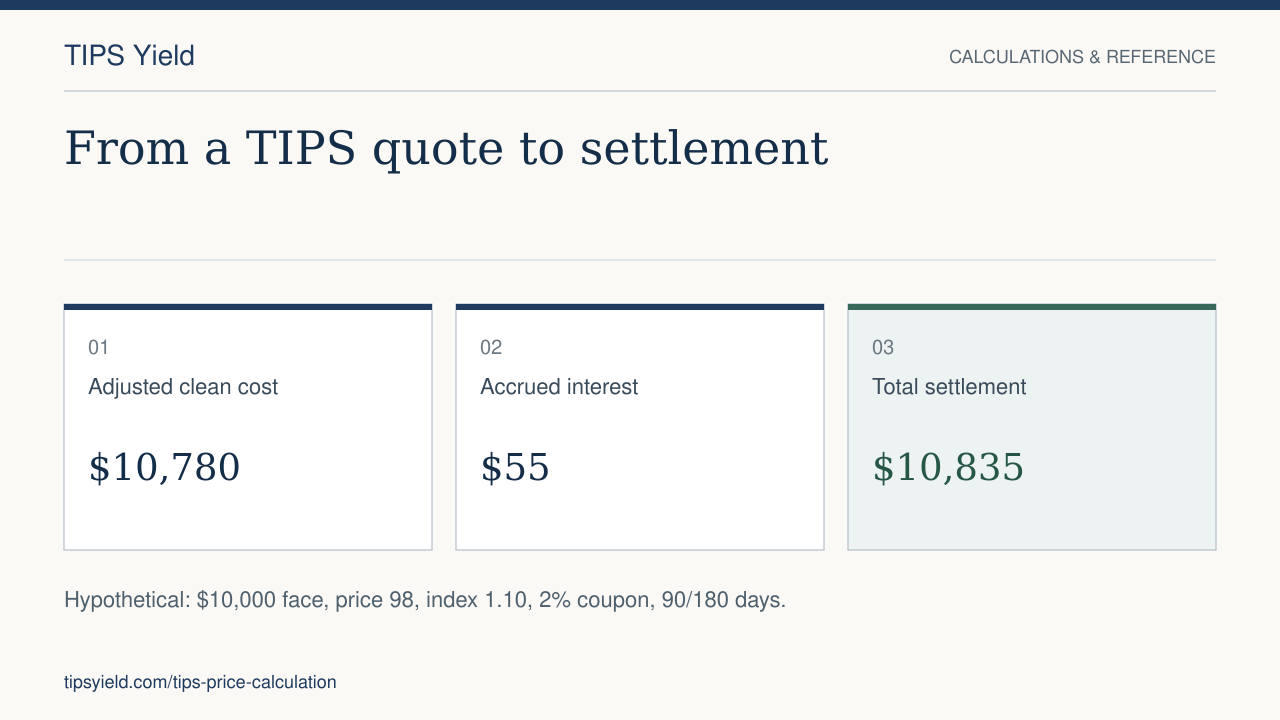
Here is the same logic with round numbers. Assume $10,000 original face amount, a clean price of 98.00, a settlement index ratio of 1.10000 and a 2% annual coupon. Assume 90 days of a 180-day coupon period have passed, and no separate fee.
| Step | Calculation | Amount |
|---|---|---|
| Adjusted principal | $10,000 × 1.10000 | $11,000.00 |
| Clean purchase value | $11,000 × 98 / 100 | $10,780.00 |
| Accrued interest | $11,000 × 2% / 2 × 90 / 180 | $55.00 |
| Total settlement | $10,780 + $55 | $10,835.00 |
This is an invented arithmetic example, not a quote. Real accrual uses actual settlement and coupon dates, including any unusual first coupon period.
Two common double-counting errors
If a ticket already shows inflation-adjusted interest, do not apply the index ratio again. If it already shows the inflation-adjusted principal cost, do not multiply that subtotal again either.
Also check the unit. A quote may be per $100 or per $1,000, while your order may show a number of bonds. Reconcile the final cash requirement from the ticket rather than copying a subtotal into the wrong unit.
Why price and yield are different
The coupon stays fixed when a TIPS changes hands. Its price changes, which changes the real yield on the remaining cash flows. A 2% coupon does not mean you are buying a 2% real yield.
The July 2036 bond shows the link. In July 2026 it sold at a real yield of 2.438% and a real price of about 99.44. In September it sold at 2.653% and a real price of about 97.61. A real-yield rise of 0.215 points cut the real price by about 1.8%. For a bond with almost ten years left, that is about what duration predicts.
What the maturity floor covers
Treasury's maturity protection covers original principal. It does not guarantee return of your full purchase cost, including a premium or accumulated inflation adjustment. Accrued interest paid to a seller is part of settlement, not extra face amount.
For market-price risk, read selling TIPS before maturity. For tax basis and accrued interest, see the tax reference.
Use the right estimate for the task
The ladder calculator uses a simplified par-purchase model for planning. It does not do this security-specific settlement calculation. Use it to understand the plan's scale, then reconcile actual securities and prices before placing orders.
See how to buy TIPS for the order checklist, the maturity schedule for available bonds, and methodology for the model's assumptions.
Frequently asked questions
Why is my TIPS cost higher than face value times the price?
Because the price applies to inflation-adjusted principal. Multiply face amount by the index ratio first, then by the price per $100. Accrued interest is added on top.
Where do I find the index ratio for a TIPS?
TreasuryDirect publishes daily index ratios for each CUSIP on its TIPS/CPI data page. You can also compute it from CPI-U with the Appendix B formula.
Does the TIPS price quote include inflation?
A secondary-market quote is usually a real clean price, before the index ratio. Treasury auction results report the index ratio alongside the price. Check which basis your broker displays.
How is accrued interest calculated on TIPS?
Take the days since the last coupon divided by the days in the coupon period, times half the annual coupon, times the index ratio. Treasury's example uses 92 of 184 days on a 3⅝% coupon to get 0.915983 per $100.
Why can an index ratio be below 1?
The reference CPI on the settlement date is below the reference CPI on the dated date. This happens when CPI-U falls after a bond is issued, as it did for the July 2036 TIPS in September 2026.