Selling TIPS before maturity
You can sell an individual TIPS before it matures, but the proceeds depend on its market price. The maturity principal floor is not a promise that you can sell for your purchase cost whenever you choose.
Why the price can fall
When real yields rise, existing fixed-coupon cash flows become less valuable at market prices. Inflation may be raising adjusted principal at the same time. Those forces can pull in opposite directions, and either can win.
Remaining maturity, coupon, real-yield changes and the shape of the yield curve all affect pricing. A broker's bid can also differ from a displayed midpoint or statement value.
What happened to three TIPS in 2022
Treasury reopened several TIPS during 2022, which gives a public market price for the same bond at different dates. Real yields rose sharply that year while inflation was high. The table shows the price per $10,000 of original face amount at each auction settlement.
| Bond | Settlement | Real yield | Index ratio | Price per $10,000 face | Price change from first sale |
|---|---|---|---|---|---|
| 0.125% TIPS, January 2032 | January 31, 2022 | −0.540% | 1.00253 | $10,708.15 | First sale |
| 0.125% TIPS, January 2032 | March 31, 2022 | −0.589% | 1.01396 | $10,870.51 | +1.52% |
| 0.125% TIPS, January 2032 | May 31, 2022 | 0.232% | 1.03672 | $10,261.68 | −4.17% |
| 0.125% TIPS, February 2052 | February 28, 2022 | 0.195% | 1.00142 | $9,810.27 | First sale |
| 0.125% TIPS, February 2052 | August 31, 2022 | 0.920% | 1.06397 | $8,461.53 | −13.75% |
| 0.625% TIPS, July 2032 | July 29, 2022 | 0.630% | 1.00495 | $10,044.65 | First sale |
| 0.625% TIPS, July 2032 | September 30, 2022 | 1.248% | 1.01972 | $9,613.35 | −4.29% |
| 0.625% TIPS, July 2032 | November 30, 2022 | 1.485% | 1.02147 | $9,429.46 | −6.12% |
Auction high yields and prices from TreasuryDirect auction records. Prices include the index ratio and exclude accrued interest. Download every result since 1997 from the auction results page.
In each case the index ratio rose. The 2052 bond's adjusted principal grew 6.25% in six months. Yet anyone who bought at the first auction and sold near the later one would have received less than they paid, before coupons. The longer the bond, the larger the drop. Its real price, with the inflation adjustment removed, fell about 18.8% on a real-yield rise of 0.725 points. That implies a duration of roughly 26 years.
None of this affected what those bonds pay at maturity. The 2032 and 2052 holders who kept their bonds still receive adjusted principal on the maturity date.
A price-sensitivity estimate
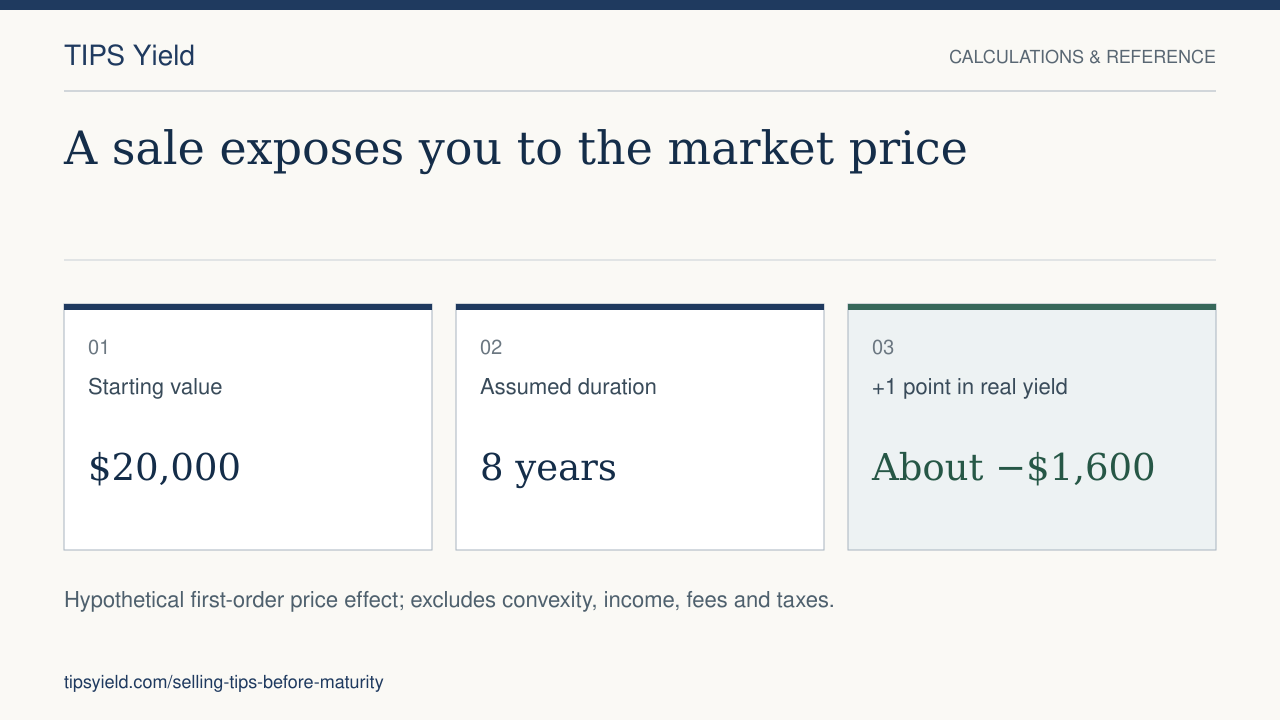
Suppose a hypothetical holding has a market value of $20,000 and a modified duration of eight years. A simple first-order estimate is:
Percentage price change ≈ −duration × change in yield
| Change in real yield | Estimated price effect | Value after price effect |
|---|---|---|
| −0.50 percentage points | +4%, or +$800 | $20,800 |
| +0.50 percentage points | −4%, or −$800 | $19,200 |
| +1.00 percentage point | −8%, or −$1,600 | $18,400 |
This isolates price sensitivity. It omits coupons, inflation adjustments, convexity, trading costs and taxes, so it is not a total-return projection. Actual prices need a security-specific calculation. For an individual TIPS, duration is close to, but below, the years remaining to maturity. Higher coupons shorten it more.
Hold-to-maturity cash flow versus sale proceeds
If the bond matures when you need its principal, a fall in the interim price does not force a sale. If you need money sooner, the amount you can raise matters even though the maturity value is protected.
This is why matching dates is useful. It is also why buying a later maturity to fund a gap year brings a different risk from owning a matching maturity. A higher quoted yield on the later bond is not free compensation.
Where the sale happens
TreasuryDirect does not sell securities for you. You must work through a bank, broker or dealer. A TreasuryDirect holding must first be held in the account for 45 days, then transferred to the commercial book-entry system. A security maturing within 45 days of purchase cannot be sold or transferred. Read TreasuryDirect's sale instructions before relying on quick access.
At a brokerage, check the actual bid for your quantity, any transaction charge, the settlement date and when proceeds become available. Small lots may get a lower bid. Reconcile the quoted clean price with the index ratio and accrued interest.
Taxes when you sell
The buyer pays you accrued interest for the part of the coupon period you held. IRS Publication 550 says you report that part of the sale price as interest income for the year of sale.
Your basis is not just what you paid. Under IRS Publication 1212, your basis rises by the inflation adjustments you included in income as original issue discount, and falls by any deflation adjustments used to offset interest. Gain or loss is figured against that adjusted basis. In a taxable account, the sale of a bond with years of inflation accrual may show a smaller gain, or a loss, than the raw price change suggests. Keep your Forms 1099-OID.
Questions to answer before selling
- How much cash is needed, and on what date?
- What bid is available for the quantity you would sell?
- What is your adjusted tax basis, and what gain or loss results?
- Which future spending year loses its funding?
- Will another holding or reserve replace that cash flow?
Judge the revised plan after a sale, not just the gain or loss on the ticket. Review how a ladder's cash flows fit together, rerun the ladder calculator with the changed holdings, and see TIPS taxes before deciding how to fund the change.
Frequently asked questions
Can you sell TIPS before maturity?
Yes. TIPS trade in the secondary market. You sell through a bank, broker or dealer at the current bid. TIPS held at TreasuryDirect must be held 45 days and then transferred out before they can be sold.
Do you lose money selling TIPS early?
Only if the sale price is below what you paid. That happens when real yields have risen since purchase. In 2022, three TIPS that Treasury reopened fell between 4% and 14% in price within months, even as their principal rose with inflation.
Is there a penalty for selling TIPS early?
There is no Treasury penalty. The cost is market risk, the bid-ask spread and any broker fee. I Bonds are different: they forfeit three months of interest if cashed before five years.
How is a TIPS sale taxed?
Accrued interest received at sale is interest income. Gain or loss is measured against your basis, which includes the inflation adjustments you already reported as income. See IRS Publications 550 and 1212.
Does the deflation floor apply if I sell?
No. The floor applies only at maturity, to the original face amount. A sale before maturity gets the market price.