TIPS versus I Bonds
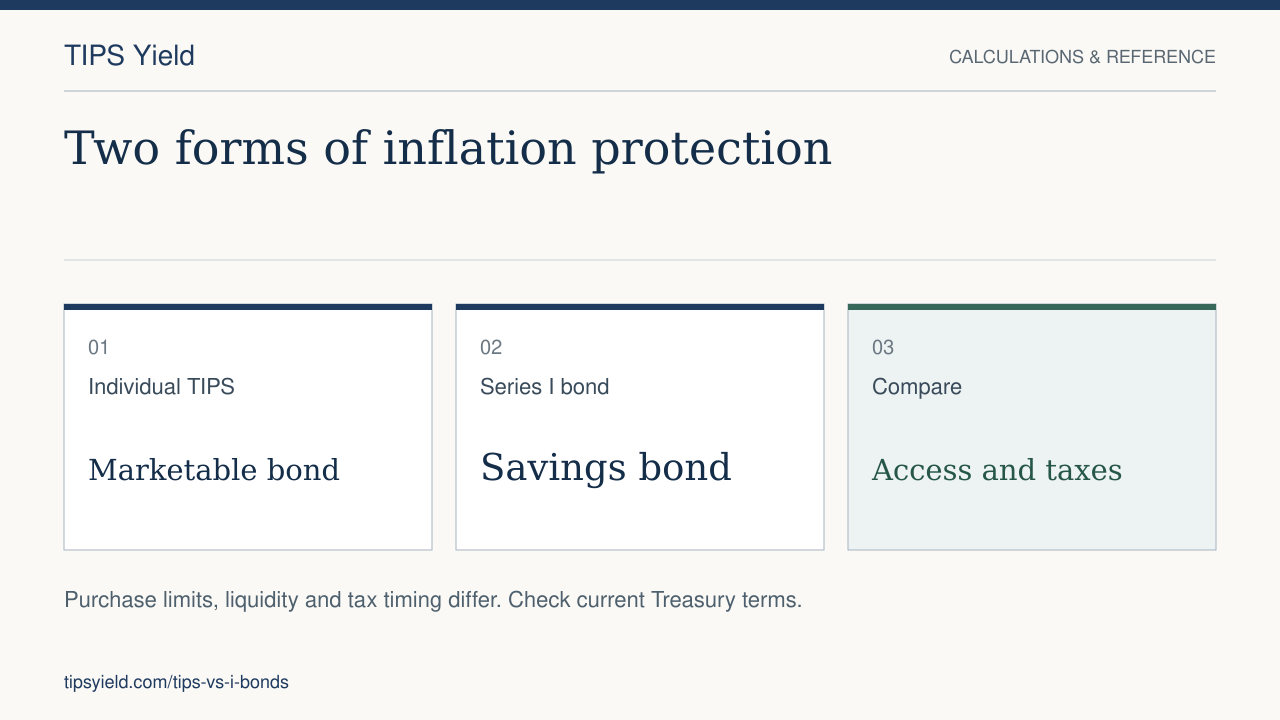
TIPS and Series I savings bonds both address inflation, but their access, cash flows and pricing work differently. Start with when you need the money, how much you want to invest, and whether you need regular cash payments.
The practical differences
| Question | Individual TIPS | Electronic Series I bonds |
|---|---|---|
| Purchase route | Treasury auction or secondary market | TreasuryDirect |
| Minimum | $100 through TreasuryDirect; broker denominations may differ | $25 |
| Annual purchase limit | Different auction bidding limits; not the I Bond annual cap | $10,000 per SSN or EIN under the stated registration rules |
| Interest cash flow | Semiannual coupons | Interest accumulates until redemption |
| Access | Can sell at market price; a TreasuryDirect holding must first be transferred | Generally cannot redeem for the first 12 months; redemption before five years forfeits the last three months of interest |
| Inflation mechanism | Adjusted principal and coupons | Composite rate combines a fixed component with a periodically reset inflation component |
Terms checked September 11, 2026 against TreasuryDirect TIPS and TreasuryDirect I Bonds. Check current eligibility, registration and limits before purchasing.
Compare rates on the same basis
An I Bond's advertised composite rate includes an inflation component and applies for a limited rate period. A TIPS quote is a real yield associated with a market price. Putting those headline percentages beside each other does not settle which investment will produce more spendable money.
List the fixed and variable components, how long they apply, when cash is available, and any tax or early-redemption effect. Use the actual purchase date and terms rather than an old headline rate.
Two cash-flow examples
If you need money in six months, an ordinary new I Bond purchase's initial lockup conflicts with that need. A TIPS can be sold, but that introduces market-price risk; liquidity is not the same as price certainty.
If you are building a large series of annual retirement payments, the I Bond purchase limit and interest accumulation differ from assembling individual maturities. TIPS can be selected by date, subject to actual availability and missing years.
Tax timing changes the comparison
I Bond owners can generally defer federal reporting of interest until redemption or final maturity, subject to the reporting method chosen and applicable rules. Taxable TIPS holdings can create current taxable principal adjustments. Both require attention to their own tax rules; see TIPS phantom income.
A tax-timing preference does not override a need for accessible cash. Evaluate the complete holding period and account rather than choosing from a single tax feature.
Where each belongs in your research
For smaller purchases with no immediate need for income, investigate I Bond terms and access restrictions. For matched future cash flows, investigate individual TIPS ladders. If you want an ongoing fund allocation, compare funds and individual bonds.
Series I savings bonds are not the same product as the iShares iBonds ETF family. Similar names do not imply the same issuer, protection or redemption rules.