TIPS Ladder ETFs: The iShares iBonds Term TIPS Lineup
A TIPS ladder ETF approach uses one fund per maturity year instead of one bond per year. The funds reviewed here are all iShares iBonds Oct 20XX Term TIPS ETFs. Each one holds TIPS that mature in its named year. This page lists the lineup as of late September 2026, explains how a defined maturity fund works, and compares the cost with holding TIPS directly.
The iBonds Term TIPS lineup
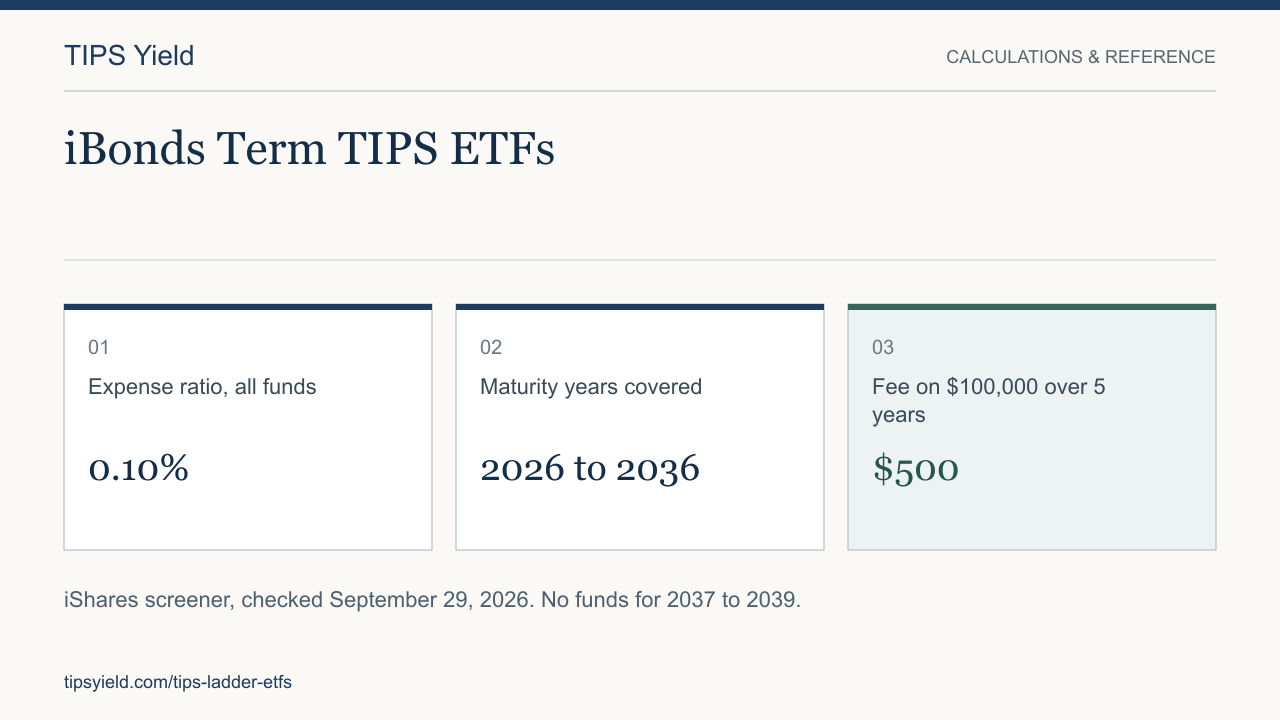
All eleven funds show a gross and net expense ratio of 0.10%. Net assets come from the iShares screener in late September 2026 and change daily.
| Maturity year | Ticker | Inception | Net assets | Expense ratio |
|---|---|---|---|---|
| 2026 | IBIC | Sep 13, 2023 | $74.6M | 0.10% |
| 2027 | IBID | Sep 13, 2023 | $140M | 0.10% |
| 2028 | IBIE | Sep 13, 2023 | $255M | 0.10% |
| 2029 | IBIF | Sep 19, 2023 | $127M | 0.10% |
| 2030 | IBIG | Sep 19, 2023 | $161M | 0.10% |
| 2031 | IBIH | Sep 19, 2023 | $87.4M | 0.10% |
| 2032 | IBII | Sep 19, 2023 | $73.5M | 0.10% |
| 2033 | IBIJ | Sep 19, 2023 | $62.3M | 0.10% |
| 2034 | IBIK | May 22, 2024 | $91.8M | 0.10% |
| 2035 | IBIL | Mar 25, 2025 | $50.0M | 0.10% |
| 2036 | IBIM | Mar 25, 2026 | $26.0M | 0.10% |
Sources: iShares IBIG page and the iShares product screener (search "term tips"), checked September 29, 2026. Net assets are screener figures from late September 2026. The 2026 fund is the nearest maturity. No 2025 fund is listed.
How a term fund works
Each fund tracks an index of TIPS maturing in one year. The sponsor describes the design as a defined maturity. The fund is designed to mature in October of its year and return its assets to shareholders. That is the sponsor's stated intent. Read the prospectus for the exact terms, including how and when proceeds are paid.
The 2026 fund, IBIC, is designed to mature next month, October 2026. If you hold it, check the iShares page and prospectus for what happens next.
This differs from an ordinary TIPS ETF, which holds bonds of many maturities and never ends. An ordinary fund has no maturity date. A term fund does.
IBIG as an example
IBIG tracks the ICE 2030 Maturity US Inflation-Linked Treasury Index. As of September 28, 2026, it held 4 bonds and had an effective duration of 3.54 years and a real yield of 2.72%. It pays distributions quarterly. Sponsor text says it "seeks to track an index of U.S. Treasury Inflation-Protected Securities (TIPS) maturing in 2030" and offers "a way to seek inflation protection, build a bond ladder, and manage interest rate risk with a defined maturity."
Distributions vary with inflation accruals, so a past payment is not a forecast of the next one. A fund's real yield is also not the same as what a specific investor will earn.
Where there are no funds
No term funds exist for 2037, 2038 or 2039 because no TIPS mature in those years. The gap affects any ladder, fund based or not. See TIPS ladder gap years for the ways to handle it.
Cost compared with holding TIPS directly
You can buy TIPS at auction or on the secondary market and hold them with no ongoing fund fee. A term fund charges 0.10% a year inside the fund. A simple estimate multiplies the balance by the expense ratio and by the years held.
| Item | Fund of $100,000 | TIPS held directly |
|---|---|---|
| Fee per year | $100 | $0 |
| Fee over 5 years | $500 | $0 |
This is a comparison convention. The direct route has its own costs, such as dealer spreads and the time to buy each bond. See what a TIPS ladder costs for those.
Check the bid/ask spread
These funds are small. The largest listed above is $255M and the smallest is $26.0M. Smaller funds can trade with wider gaps between the buy and sell price. Look at the current bid/ask spread before placing an order, and consider a limit order. This page does not cite spread figures, because they change through the day.
When each ladder type fits
| Question | Term ETF ladder | Individual TIPS ladder |
|---|---|---|
| Ongoing fee | 0.10% a year | None from the bond itself |
| Purchase size | Any number of shares | Set by Treasury minimums and dealer lots |
| Maturity coverage | 2026 to 2036 only | Any year with an outstanding bond |
| Payout at maturity | Fund designed to return assets in October of its year | Treasury pays principal at maturity |
A term ETF ladder may suit an investor who wants simple share purchases in a brokerage account. Individual TIPS may suit an investor who wants no fund fee and exact cash on a known date. Neither is a recommendation. The funds versus individual TIPS page explains the underlying difference.
Next steps
Size your spending years in the ladder calculator. Read the ladder walkthrough and how to buy TIPS if you plan to hold bonds directly. The broader ETF comparison covers funds without a set maturity. This page is general information, not a recommendation.
How the figures were computed
The fee estimate is balance × expense ratio × years. With a constant $100,000 balance, 0.10% gives $100 a year, and 5 years gives $500. Actual fund expenses accrue inside the fund and depend on asset values over time. The table figures are from the iShares screener and IBIG page, checked September 29, 2026, with IBIG data as of September 28, 2026.